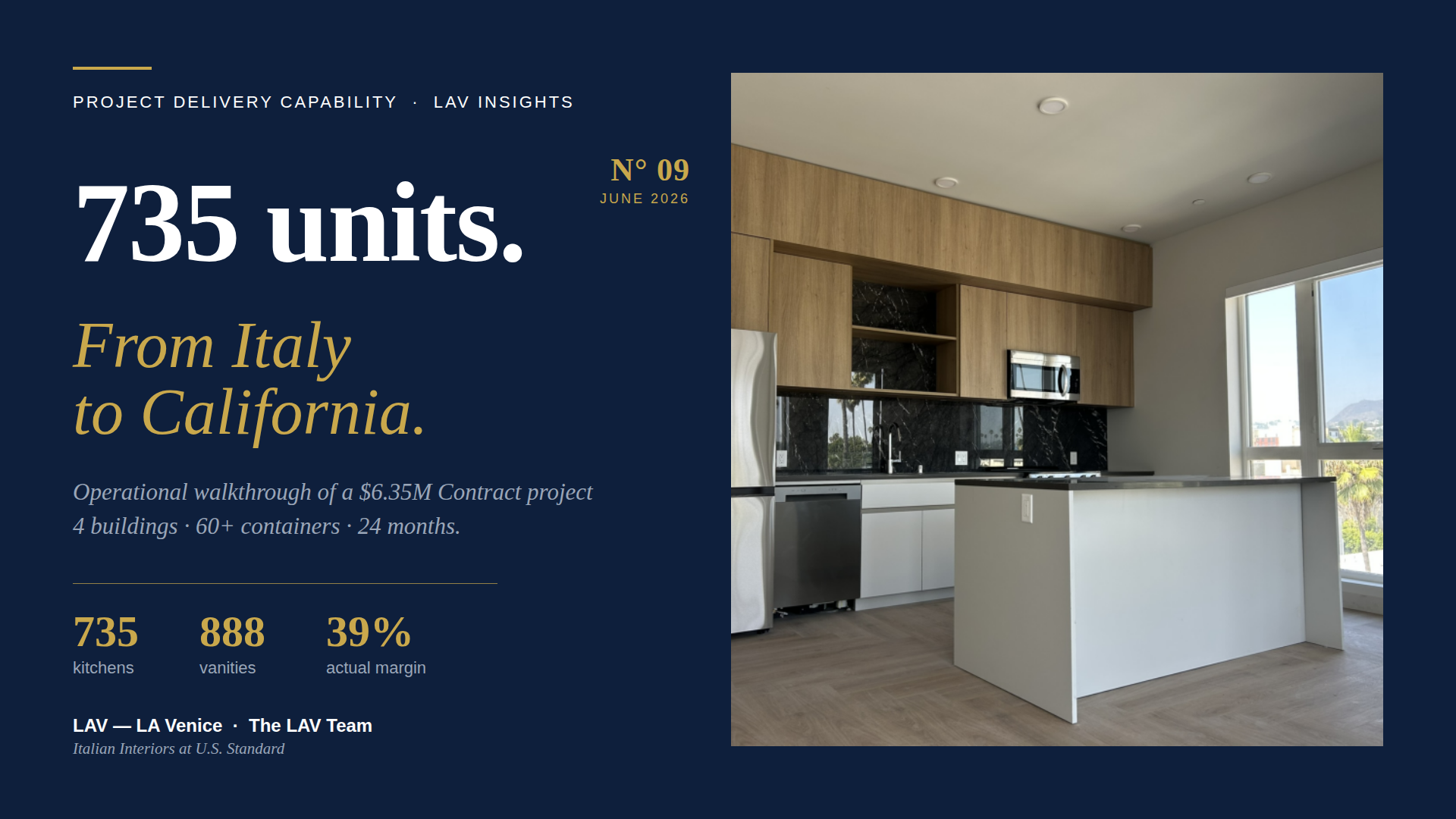
A $6.35M contract. Four buildings, more than 60 containers, 735 kitchens, 888 bathroom vanities, two years of jobsite. Planned margin: 33%. Actual margin at closeout: 39%.
This is not a story about price. It is a story about process control. Here it is, phase by phase.
The project in numbers.
A multi-building residential complex on the U.S. West Coast. Four buildings — Building A, B, C, D. 735 dwelling units across multiple floors. The Italian Design supplier, specialized in fixed casework, is awarded full supply and installation of kitchen cabinetry and bathroom vanities.
The technical scope is clean. Included: 735 kitchens in eight typologies, 888 bathroom vanities in more than ten typologies, kitchen islands, full installation, project management, and on-site coordination. Excluded: countertops, appliances, and stone surfaces — covered by other trades.
Lump-sum contract. Value: approximately $6.35M. Signed in December 2023. The executive reference document for the entire life of the project is invoked in every subsequent reconciliation.
The technical specifications.
Five product choices define the spec. They are the foundation of everything that follows, because no one selling Italian Design casework into a large U.S. residential complex can show up with a watered-down version of their European standards. The U.S. high-end residential market demands explicit compliance, full traceability, and complete documentation.
- Cabinet carcasses in 18 mm engineered wood panel, dowelled and glued, melamine-finished. V100 water-repellent core, TSCA Title VI compliant, FSC-certified.
- Doors in low-thickness laminate with “shark nose” profile, Alcene Anthracite Linen finish. Color continuity and grain matching is a controlled variable per production batch, tracked via archive sample.
- Drawers with full-extension soft-close slides. C-channel handle on every kitchen. Uniform opening standard across all 735 kitchens delivered.
- ADA-compliant sink bases with removable bottom liner. ADA / FHA compliance extended across the full box program. This is not a minor detail: on a multi-building U.S. residential complex, regulatory inspection on these requirements can block the certificate of occupancy.
- Six-way wall cabinet hanging system with adjustable levelers. Every wall cabinet can be aligned in plane and out of square without full removal. It’s an operational detail that, on site, saves three days of work per building.
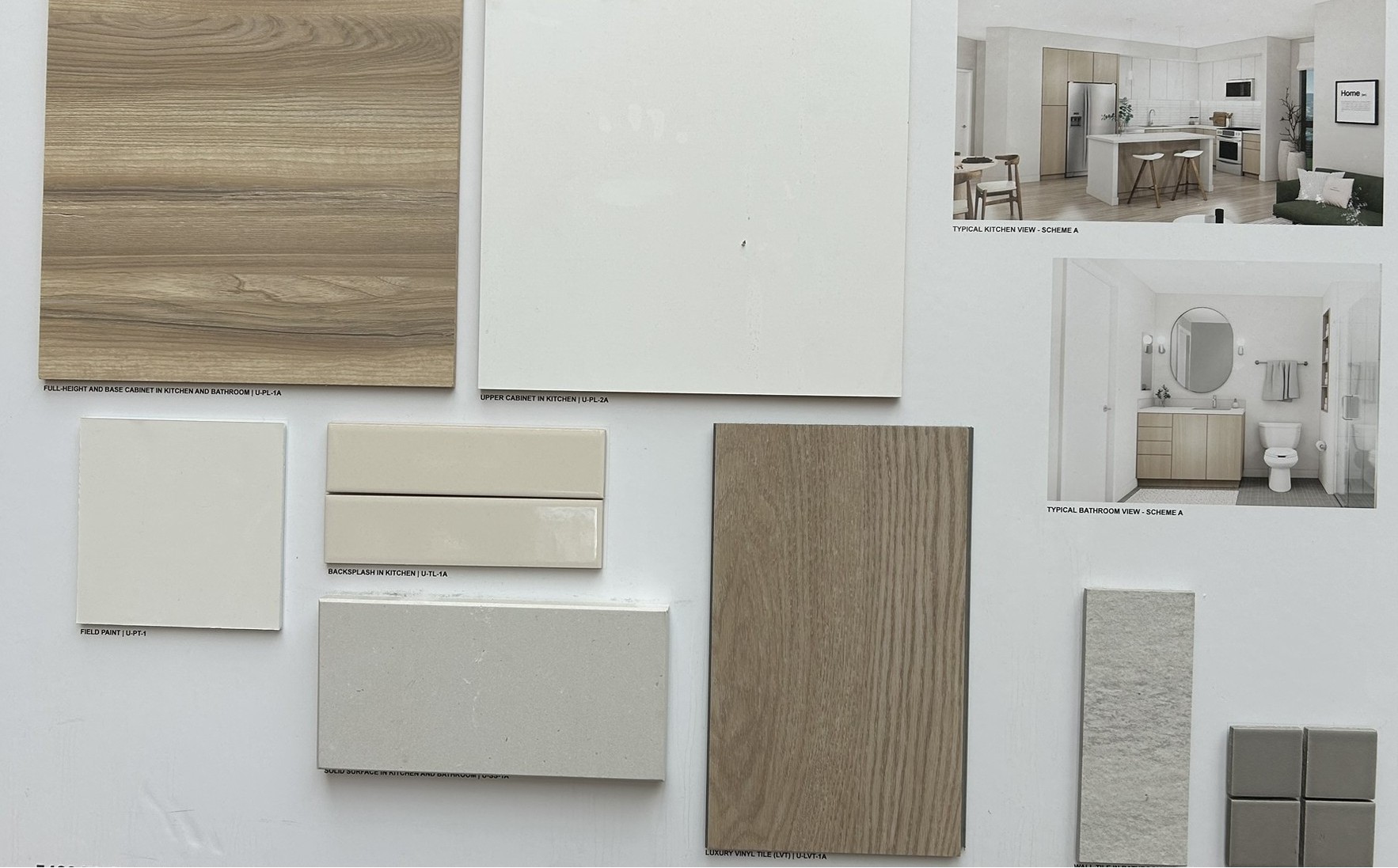
The mock-up. Five revisions before a single container ships.
Between spring and summer 2024, a complete unit is assembled in the factory in Italy. It’s called the mock-up. It’s the dress rehearsal of everything: dimensions, finishes, hardware, alignments, look-and-feel. The Client and the design firm are convened on site for joint inspection.
Five revisions in sequence: REV.0, REV.1, REV.2, REV.3, REV.4. Each revision documented, signed, archived. The factory demonstration assembly is recorded on video. Anything that could become a point of contention on the jobsite is resolved earlier — in the factory, with the real product, in front of the same stakeholders who will sign at project closeout.
This is the first principle of the model: the mock-up is not a marketing exercise. It is the moment when the profitability of the entire contract is protected — because every defect caught in the factory costs one hundred times less than the same defect found on the jobsite four thousand miles away.
Every defect caught in the factory
costs one hundred times less
than the same defect found on the jobsite.
One mock-up per typology is then installed at the jobsite and remains available to the Site Manager. In case of doubt, the Site Manager can verify any detail in person. Each mock-up carries all product specifications, and installation is performed ad hoc on the reference unit. The Project Manager and the Client co-certify the correctness of the reference mock-ups.
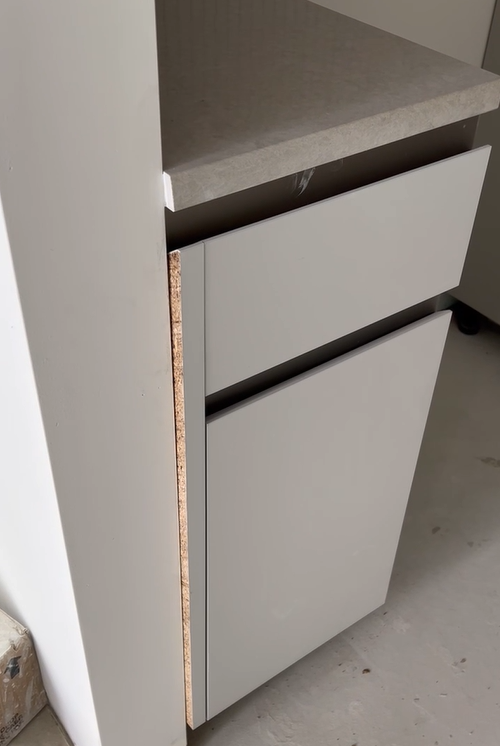
More than 60 containers, just-in-time.
Once prototyping closes, production starts. The contract is delivered through more than 60 forty-foot ocean containers, plus a few air shipments for urgent fillers. The starting logic is not serial (“produce everything, then ship”). It is just-in-time: each container ships based on the actual progress of the U.S. jobsite.
That means coordinating three different clocks. The clock of Italian production (installed capacity, factory scheduling). The clock of ocean shipping (roughly four weeks of Atlantic crossing, plus customs days). The clock of the U.S. jobsite, which moves building by building and floor by floor.
Packaging is per-unit, not bulk. Each kitchen travels with its own hardware separated into labeled boxes. Each container is mapped to the destination apartment cluster. When the container’s seals are broken at the port, every box already knows which apartment it will land in.
This is the second principle of the model: logistics is not a cost to be minimized. It is an information architecture to be designed before the contract is signed. On a project of this size, binding packaging and labeling to apartment numbers eliminates the risk of on-site mix-ups — a risk that, if materialized, can cost $30K–$50K per apartment.
Jobsite 2025. Installation in waves, building by building.
2025 is the most complex season. Installations proceed in waves, building by building and floor by floor. Logistics, unloading, crew mobilization, and unit completion overlap daily. In the first days of January 2025, the first operational theme appears: the Cabinet Installation Default Notice & Unit Completion Confirmation. The Client wants certainty of closeout, unit by unit.
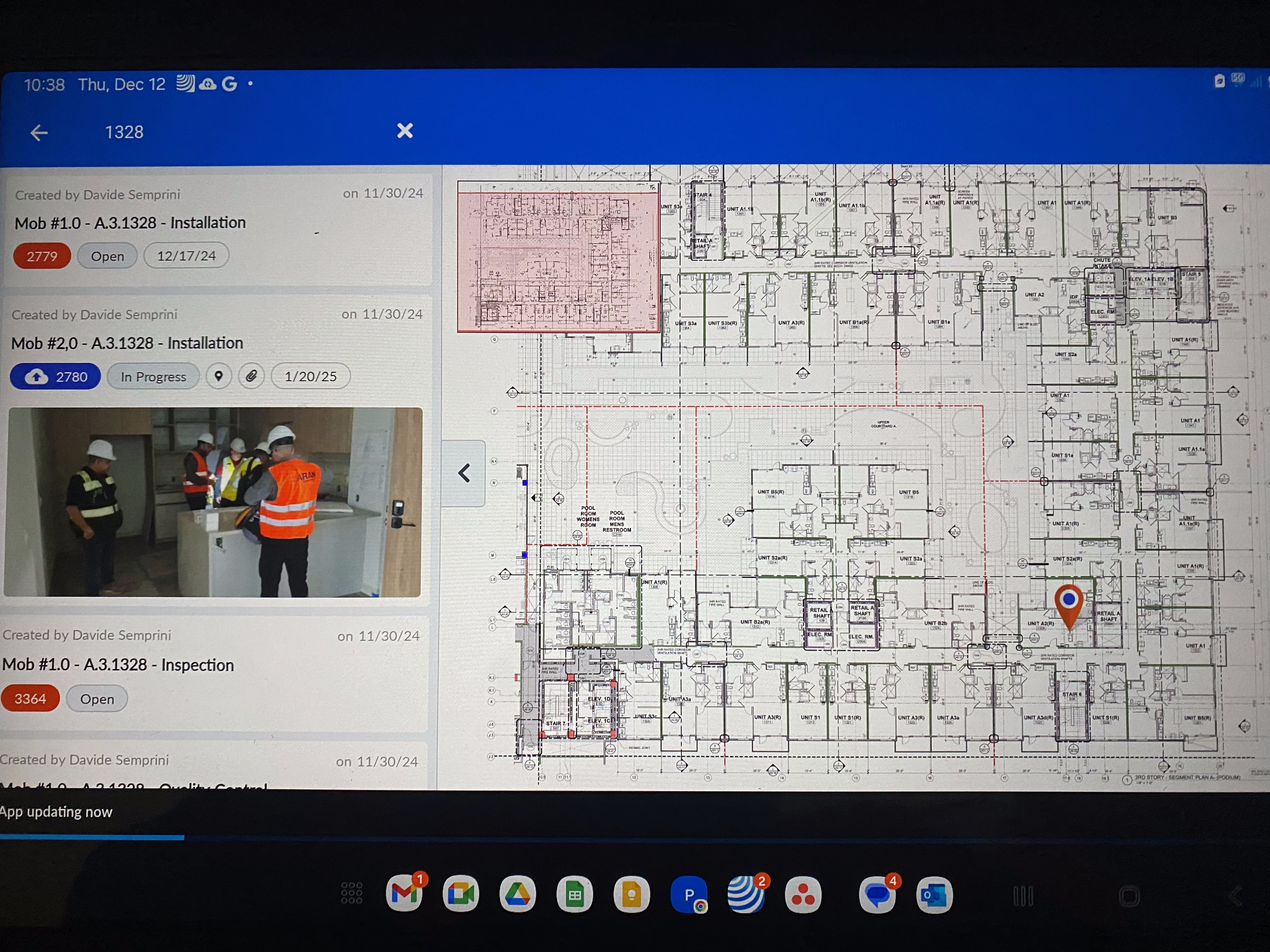
The answer is reporting discipline. Real-time monitoring systems on jobsite progress. A ticket opened for every reorder. A daily project status report transmitted to the Client. Every morning, the same document says what was installed the day before, where, and what is scheduled for the next forty-eight hours.
Weekly, a coordination meeting with the Client tackles the week’s change order approvals. The PM and the commercial lead attend when needed. It is in these meetings that operational adaptations are negotiated — ADA sink bases, levelers, vanity adjustments, dishwasher and tall-unit modifications, ledgers, storage — feeding the backlog of approved change orders.
The floor stop. The single most expensive operational event.
Around the fourth month of jobsite, the single most expensive event of the entire contract occurs. The floor installation — under another contractor — stops. Our work has to slow proportionally: kitchens and vanities cannot be installed on floors that are not yet there.
At that moment we have about thirty people on site. The slowdown forces us to lose roughly fifty percent of crew capacity: some removed, some redeployed to other projects, some seeking work elsewhere. When the floors resume, the Client accelerates to recover lost time. But we no longer have the installation capacity.
Onboarding new field crew takes a minimum of fifteen days: selection, training, ramp-up. Under pressure to close units, the Client inserts its own crew on our scope, at our cost. When our crew returns to full capacity, we also have to remediate the errors of the quickly-trained teams: material rework, quality remediation, supervisory overtime.
Final additional cost on the U.S. entity: installation rises from roughly $1.35M to about $1.65M. Plus $280K of net extra cost, generated by a variable outside our perimeter.
How margin was protected. The risk buffer.
Despite $280K of acceleration extra cost, the final project margin did not erode. In fact, it grew. Aggregate margin Italy + U.S.: from 33% planned to 39% actual. In absolute value: from about $1.95M to about $2.6M. The global result was pulled up by U.S. margin, which rose from 17% to 24%.
The mechanics are simple to explain, complex to apply. At bidding stage, the contract was structured with budget buffers calibrated to the risk grade of each individual phase. When an unpredictable variable materialized — the floor stop, the U.S. tariffs that emerged through 2025, the quality remediations — the buffer absorbed the hit. Without eroding the planned margin.
This is the third principle of the model: the profitability of a complex Contract project is engineered upstream. It is written into the bid. It is defended every week with reporting discipline. It is never recovered after the fact — because after the fact, it is too late.
Numbers from the project management engine.
The consolidated view, updated to June 2026, captures the operational engine. Roughly 680 tasks distributed across the five project phases. Zero open tasks.
Beneath these numbers there is a discipline of opening, assignment, closing, and documentation that repeated itself every week for more than two years. It is not a marketing metric. It is an accountability metric: whoever controls this engine can open a large U.S. jobsite and close it without losing the thread of the detail.
The final result.
Consolidated final order value (U.S. entity): approximately $6.6M. Approved change orders: more than $150K. Aggregate Italy + U.S. margin: 39% at closeout, against 33% planned. Margin in absolute value: about $2.6M. U.S. entity margin: from 17% to 24%. Italy entity margin: from 34% to 35%, substantially stable, with the U.S. tariffs that emerged in 2025 absorbed by the buffers (material planning had accounted for the scheduled tariff entry into force, mitigating the impact).
735 kitchens and 888 bathroom vanities delivered and installed. roughly 680 tasks managed. Zero units delivered out of specification. A complex Contract project, closed above plan. And a Client that, today, is awarding follow-on work.
Four takeaways, for those evaluating an Italian partner.
For Developers, General Contractors, and Owners currently evaluating an Italian partner for Contract casework on a U.S. project, four readings from this story.
- Price is defended on the jobsite, not only in the bid. A margin that grows from 33% to 39% despite a critical jobsite phase is not the result of a margin “bought” at tender. It is the result of daily control: change orders, reorders, reporting. Suppliers without this discipline lose margin on the jobsite. Always.
- Complexity must be industrialized. A mock-up with five revisions. More than 60 containers just-in-time. Wave installation, building by building. roughly 680 tracked tasks. The project management engine is what makes a scope of 735 kitchens and 888 vanities governable. Without it, the same scope generates millions of dollars of unplanned cost.
- Time is the real risk. The floor stop at month four, the loss of half the field crew, the Client-driven acceleration: the time variable is what, in a Contract project, can convert into extra cost, quality loss, and rework. It must be governed, not absorbed.
- Risk is priced upstream. The budget buffers included in the bid are what absorbed crew, tariffs, and remediations. The profitability of a Contract project is engineered before the contract is signed. Not recovered after.
For the next project.
A $6M Contract project on a large U.S. residential complex is a meaningful scope, but not exceptional. What makes the difference is not the size of the contract. It is the discipline with which the details are governed: the mock-up signed in the factory, the apartment-number labeling, the daily report, the change order negotiated weekly, the budget buffer calibrated on risk.
For every next project, these are the conditions that anyone buying Italian Design casework should expect from their supplier. They are not brand attributes. They are process attributes. And processes, unlike brands, can be verified before the contract is signed.
— The LAV Team
LAV · LA Venice · Italian Interiors at U.S. Standard