Branded residences: no single maker is right for every brand
In an interior fit-out and FF&E supply, honoring the Interior Designer's concept for a branded residence is everything. A manufacturer is tied to its catalog and often forces the Interior Designer to compromise. The real value is being able to choose different makers while having one partner who coordinates every phase of a contract project, in every unit, holding the same standard from the first apartment to the last.
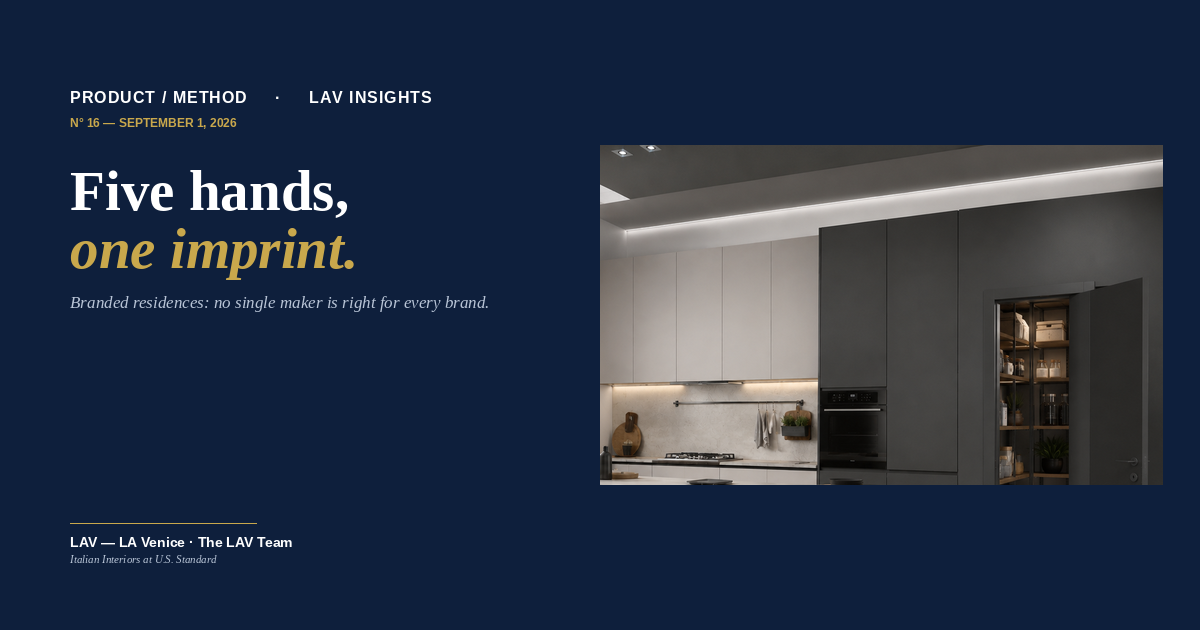
In a branded residence, every room carries two signatures: the brand that gives the building its name, and the Interior Designer who designs the interiors. Both demand the same standard, in every unit and for years. Our value is not selling a furniture brand: it is choosing and proposing, for that brand and that project, the right maker — whether a name imposed by the spec or an unbranded workshop of the highest quality — and taking it to the scale of an entire building without the standard ever dropping. Here we explain how, staying a single point of contact for the Developer and the Interior Designer.
1. In a branded residence every room has to earn two signatures
A branded residence sells two things at once: an apartment and the promise of a brand. The buyer pays for both because they trust that name, and the name puts in writing — in a brand standard — how materials, finishes, and performance must be. The Interior Designer works on top of that standard, translating the brand's promise into a design: proportions, veneers, detailing, atmosphere.
The duty of a contract partner is to satisfy both at once and to deliver the concept exactly as designed. The brand checks that the standard isn't betrayed; the Interior Designer checks that the vision reaches the site intact. A room that thrills the designer but fails the brand's review can't be delivered; a compliant room with no character doesn't justify the name on the building. Holding the two signatures together, unit after unit, is the real value.
2. Two ways to live up to the brand
Living up to a top-tier brand can be done in two ways, and on a real project they always coexist.
The first is the specified brand: the brand standard, or the Interior Designer, calls out a premium range — a name that already guarantees that level, with its documentation and certifications.
The second is bespoke fabrication, entrusted to an unbranded maker capable of a quality and customization no catalog offers. And for part of the supply it isn't a choice — it's the only way. Wall panels, flush doors, wall systems, and built-in elements don't exist in a catalog by definition: they're drawn for that space and no other.
This is where a single supplier shows its limit: it covers well the part of the project its catalog anticipates. The rest — what gives the room its character — stays uncovered, or gets compromised.
3. Our value is the project, not the product
The difference between a manufacturer and a contract company is simple: the first is focused on selling its own product, the second on the whole project and on satisfying the two signatures without catalog constraints. A manufacturer brings its catalog, and everything it touches ends up looking like it. We're tied to no one: for each room we choose the right hand for that brand and that project.
In practice that means delivering an apartment where the bedroom comes from one major furniture system, the living from another name of the same level, and the kitchen is bespoke work produced at industrial scale — with the repeatability, control, and compliance of a contract supply, not of a one-off. And the doors, wall panels, and wall systems are designed to sit in the middle of all this without the seam showing.
For the Interior Designer it's a freedom that immediately becomes value: they don't have to compromise to fit everything under a single brand, and they don't have to chase five suppliers to hold the project together. They choose the best for each room; we take on the coordination, the compliance, and the responsibility for the supply.
4. Five hands, one imprint
The uncomfortable part has to be said too. Every additional maker is one more interface, and in a high-end interior projects don't break on the single piece: they break where the pieces meet.
The bedroom veneer and the wall paneling come from different lots and have to look like the same wood. The lacquer on the door and the lacquer on the cabinet come off two lines and have to read as the same tone under the same light. The baseboard meets the wall paneling, which meets the frame, which meets the floor laid by another trade: four tolerances that have to close within a few millimeters, on every unit.
Choosing the right maker for each room is half the craft. The other half is drawing a single imprint out of them, and it's done upstream, not on site: one reference sample that every maker aligns to — not one per supplier — acceptance criteria written before and not argued after, and a mock-up of the typical room where the joints are seen, for the first time, all together. It's the only moment when correcting them costs little.
The rule we don't break: when the brand standard and a design choice conflict, or when a maker can't hold a spec, the alternative comes to the table before production, with cost and visual consequence explicit. The decision goes back to whoever designed it. The Interior Designer never loses control of the project: they gain a partner who defends it.
Our craft isn't selling a brand: it's giving each brand its right imprint, and holding that standard identical across every unit.
For the next project
If you're developing a branded residence in the United States, the question that separates a partner from a supplier isn't which furniture brand they propose. It's whether they can choose, for each room, the right maker for that brand and that project — catalog or bespoke — and hold the same imprint across every unit. Because a prestigious name that by the tenth unit is no longer the same, or a project bent to a single supplier's catalog, doesn't create value: it takes it away from the brand and the Interior Designer.
Get New Insights via Email.
One article per month. No drip sequences. Unsubscribe in one click.