How We Close the Italy→U.S. Last Mile Without Surprises
Ocean freight, customs, staging and install: how we govern the final leg so the material reaches the site when the site needs it.
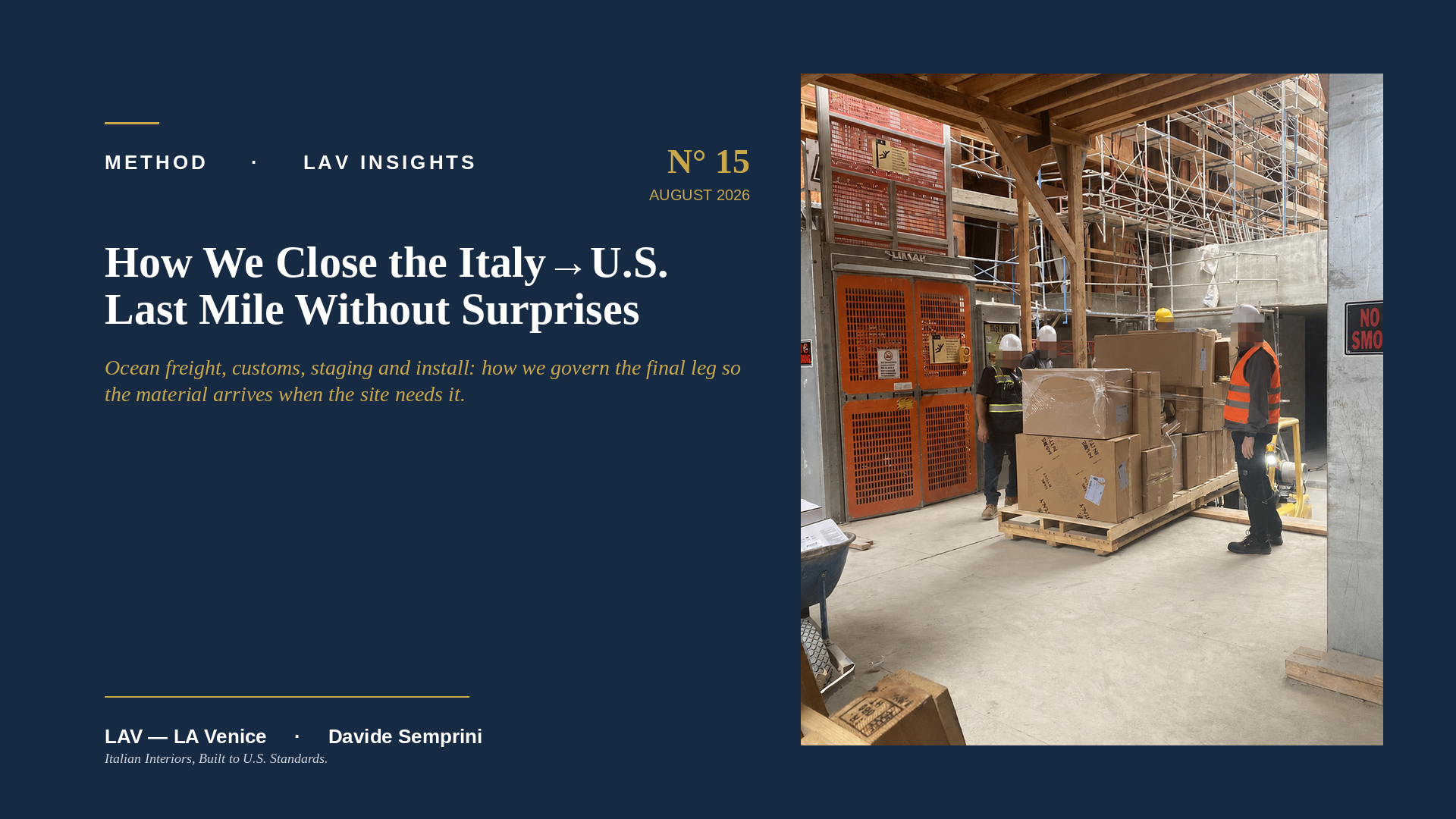
The quality of what leaves our production has to be a given: it's what we do, and what we're known for around the world. What is not a given is planning and preparing the shipment, labeling each product, and loading the containers in a way that serves the installation sequence. The ocean crossing gives little trouble, and customs, when the paperwork is done right, doesn't stall; and yet it's in the final stages — unloading and distribution — that the worst damage happens.
This is the last mile, and it's the part a manufacturer used to shipping ex-works never sees — because for them it ends when the truck pulls away. For an interior contractor it ends when the last piece is installed and approved. Here we explain how we govern that final leg, where the risk concentrates, and where most of the surprises are avoided upstream, not on the dock.
1. One number written wrong and the install has to be redone
Let's work backward. Whoever installs a kitchen, a bathroom, a door, or casework works in sequence, tied to install times that rarely leave room for idle stretches or an easy pace. The installer walks into an apartment, finds the material already there, and starts. If a piece is missing, they flag it and move to the next apartment. If the material was placed in the wrong apartment, they assemble a kitchen with two different finishes.
That's why precise distribution of the products to the right apartment is decisive for the project. Picture it: a very long process — months of design, procurement, production, and shipping — can be undone simply because an apartment number is written too small and unit 1335 becomes 1353, or because the truck was loaded with no regard for the install sequence and the kit for each room and apartment has to be rebuilt on site.
So the material can end up missing in the apartment, the install gets suspended, the material is reordered and air-freighted, with a delay that carries certain penalties and rising costs. The irony is that the material is often already on site — just placed in the wrong apartments: 1353 instead of 1335. And you know what happens: when the installer finds the material, they don't know whether the veneer is the right one. They just install. That's the double damage, because that install will never pass approval and will have to be redone entirely.
You can see the kind of complexity, cost, and disruption a trivial error sets off.
In contract work, the details make the difference.
2. The customs window is booked, not hoped for
Clearing customs isn't an unpredictable event: it's a process with known requirements, prepared before departure. The customs documentation — classification, value, origin, compliance of regulated materials — is closed while the goods are still in Italy, not once they're already at the U.S. port. A container stuck in customs for a missing document doesn't just cost days: it takes up space, generates charges, and, above all, arrives out of sequence.
That's why, where it makes sense, we take on the entire transport to destination ourselves, so the General Contractor doesn't inherit a customs risk they can't control. And we treat the transit window as a planned parameter, with a margin, not an optimistic estimate. The rule is simple: the date the material has to be on site is set at the start, and from there you count backward to the shipping date. Not the other way around.
3. The warehouse isn't a parking lot: it's a governed buffer
Almost no site can receive the whole supply at once: the ship, the customs clearance, and the on-site distribution are planned against the client's schedule. In some cases you use a nearby warehouse, but it's a solution that always means double handling and a double risk of damaging the material.
Yes, it takes planning a few days ahead, a week at most. Often it's better to create a small buffer on site and keep there the material that lets you hold a steady install pace. But a buffer is only useful if it's governed: goods labeled, tracked by position and by unit, ready to go out in the right sequence.
This is where kitting makes the difference. Instead of unloading mixed pallets, we prepare the goods the way they'll be installed: by floor, by unit, and by room. All of this is possible thanks to work done many months earlier by the project manager who, once the layouts are set, assigns them unit by unit and room by room. We call it the project MATRIX, and it's the work that governs every process downstream.
4. Delivery follows the install sequence, not the truck
Delivery to site isn't a transport problem: it's a problem of sequence and work progress, planned together with the General Contractor against the installation schedule. This planning happens 20–40 days ahead and, once the goods are on the ship, it can no longer be changed. So it requires organizing flexible work, and we handle it this way: during the mock-up installation we also industrialize the install itself, with a time-and-methods study that sets the work pace.
We plan the install against the General Contractor's schedule and size the workforce to the pace of progress. Then we plan delivery with a lead of up to one or two weeks, depending on available space, volumes, and work sequences.
The material-handling crew thus works with an average lead of one week, distributing the material and checking conformance. That way the install crews always find the material available.
5. Whoever supervises the install answers for the result
We usually work with local install crews, but supervision is entrusted to a site manager and a jobsite project manager, who coordinate every day with the General Contractor and with us in Italy for shipments. Staging the material ahead keeps us clear of delays; in fact we're often too early, because the site slips or an install sequence is changed.
In those cases we have to be flexible and adapt to the site. That's why we budget extra resources: temporary storage in case of early arrival, or small air shipments if the sequence changes and some units are installed ahead of others. It's a constant adapting to the speed of the site.
The site manager and jobsite project manager then get ahead of the owner's punch list, so any adjustments are done before handover.
The project doesn't end when the goods leave Italy: it ends when the last piece is installed and someone can sign off.
For the next project
If you're planning the arrival of Italian components on a site in the United States, the question that separates a partner from a supplier isn't how much the transport costs. It's who takes on the last mile: who closes customs upstream, who runs the warehouse as a buffer and not a parking lot, who delivers in the install sequence and stays to supervise through sign-off. Because an excellent supply that arrives late, damaged, or out of sequence isn't an advantage: it's a problem that becomes the General Contractor's.
Get New Insights via Email.
One article per month. No drip sequences. Unsubscribe in one click.