Murano: the fire that never dies
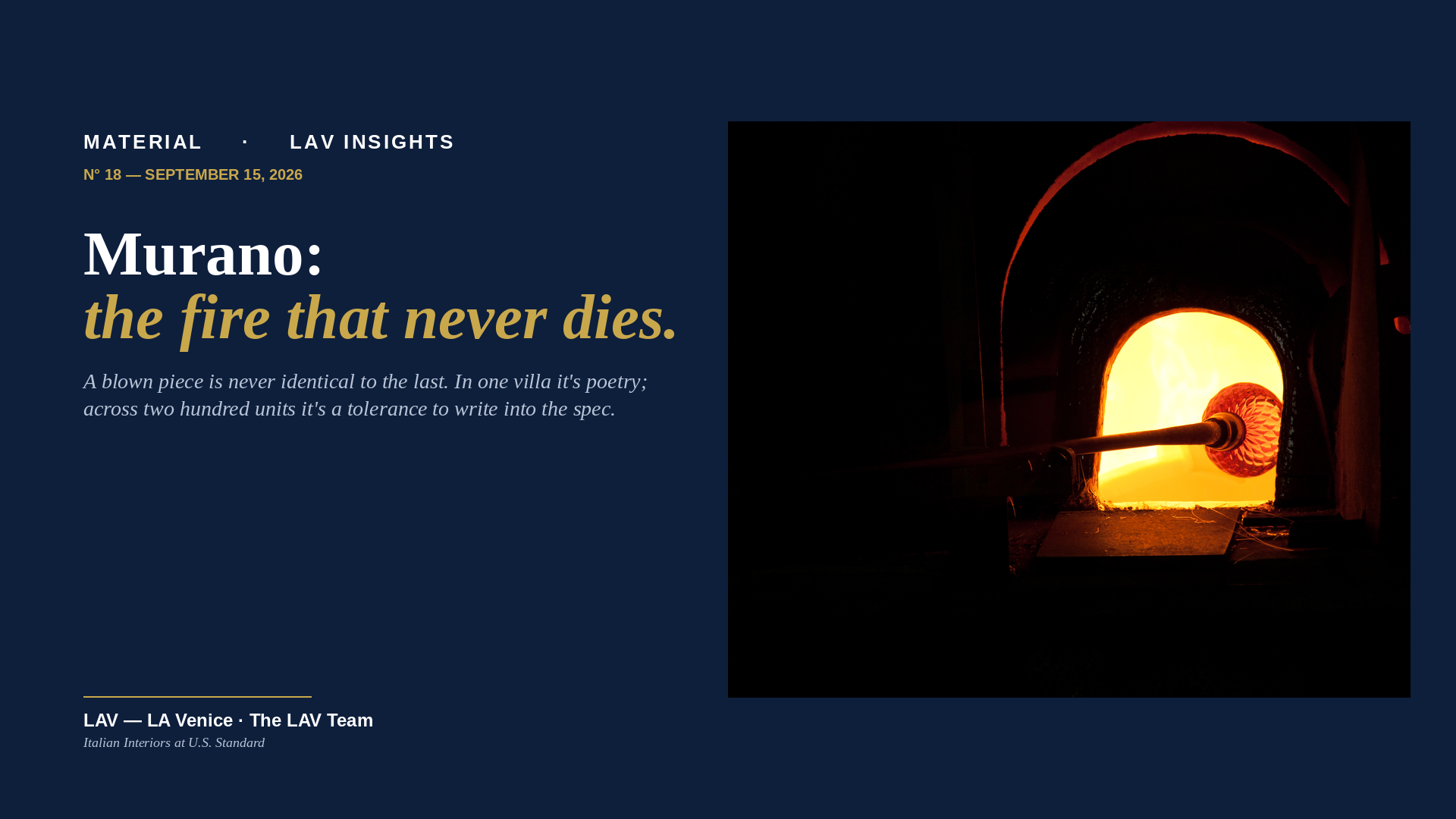
For eight centuries Murano glass has been born in front of a furnace mouth that never goes out. Alongside the island's furnaces, a fabric of companies and workshops has grown up on the Venetian mainland out of the same glassmaking tradition. From here two roads open — and for anyone designing a project, knowing which one to take matters as much as choosing the right piece.
Venetian glass is a seven-century story and a quality industry cannot replicate: every piece is hand-blown, and no two are alike. To that history a wider geography is now added and, with it, two production vocations: on one side, work oriented to the one-off piece and to the fullest expressive freedom; on the other, organizations able to govern volumes, tolerances, certifications and replacements over time. Our task is twofold: to recognize which model a project needs and — when repeatability is required — to turn the variability of the hand into a declared tolerance, written into the specification together with the Interior Designer.
1. The fire moved to the island
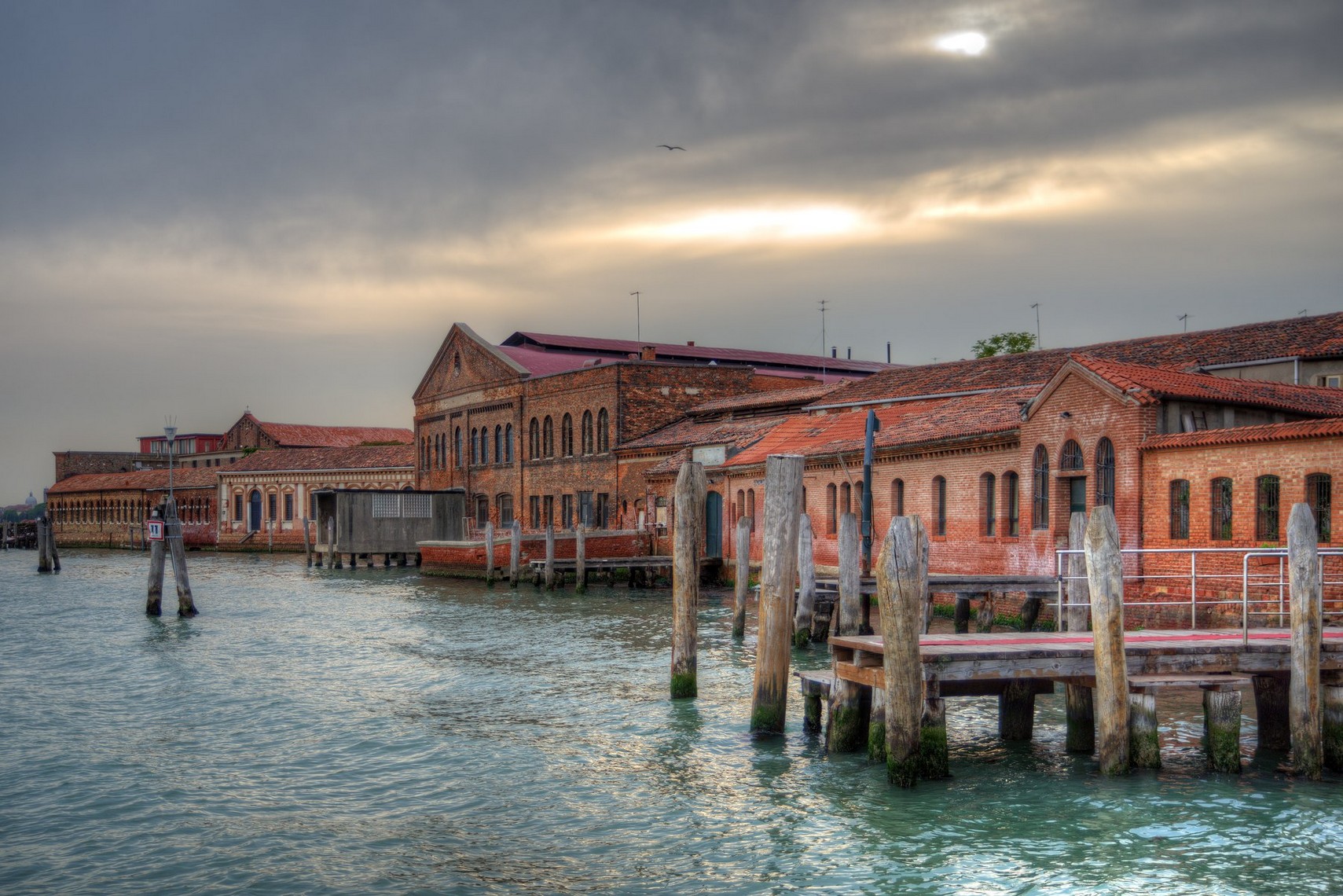
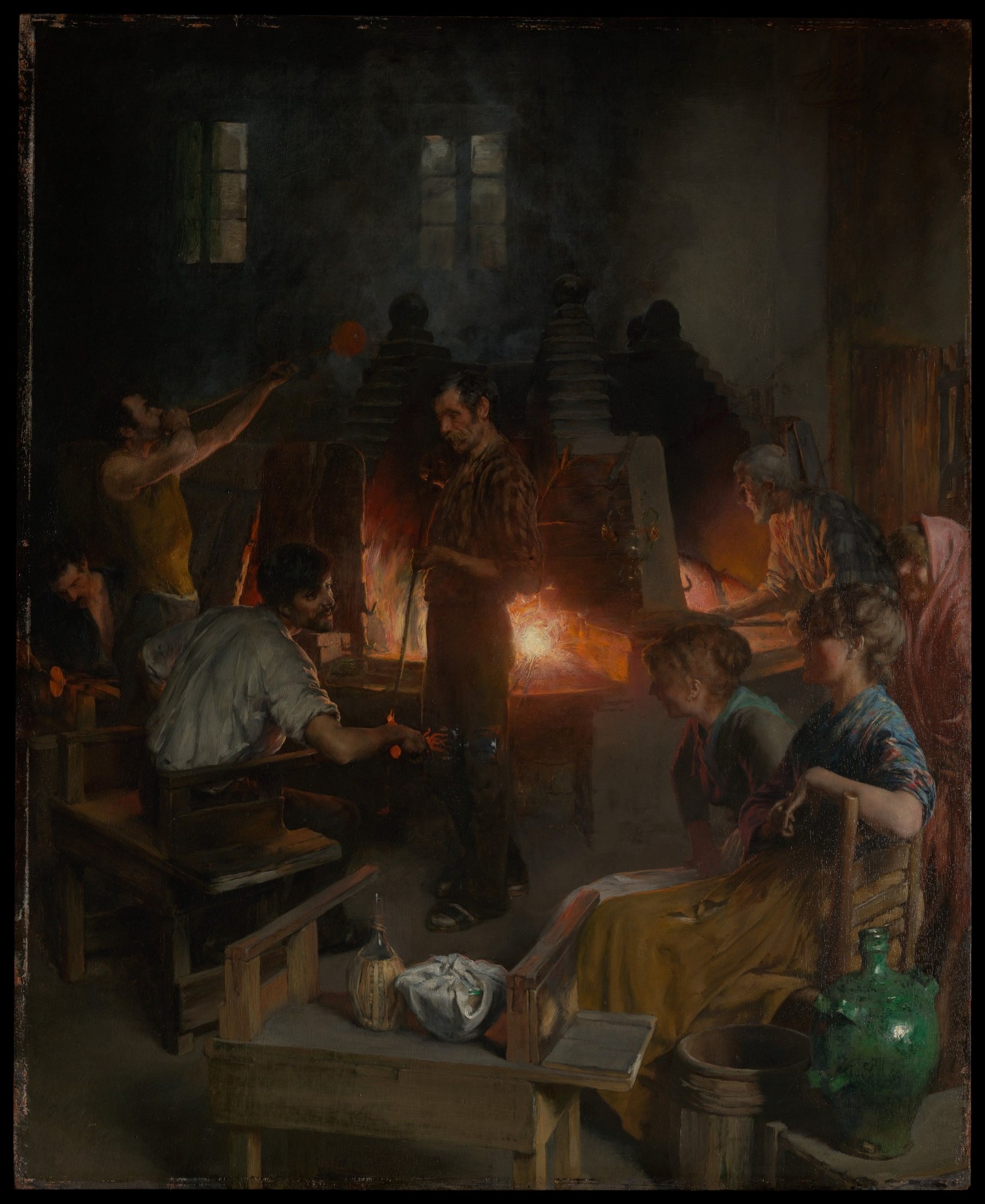
Glassmaking reaches the lagoon in the early centuries of the Middle Ages, heir to Roman and Middle Eastern techniques. In 1291 the Republic of Venice orders all glass furnaces moved to the island of Murano: the city is built largely of wood, and the continuous fire of the furnaces is an intolerable fire hazard — but it is also a way to jealously guard the secrets of the craft. The glass masters are granted an almost noble status; in return they cannot leave the Republic, under the severest penalties, to protect a monopoly that holds across Europe. Since then Venetian glass has had an address, and a fire that never goes out: the furnaces stay lit day and night, because bringing them back up to temperature costs more than keeping them alive.
2. Seven centuries of invention
The fifteenth century is the golden age: master Angelo Barovier perfects cristallo, an extraordinarily transparent glass that wins over the courts of Europe, while filigree, murrine and enameling flourish, turning everyday objects into works of luxury. Not all is ascent: between the seventeenth and eighteenth centuries foreign competition — Bohemian glass above all — opens a long crisis, and the fall of the Republic, in 1797, closes many furnaces. The revival comes in the mid-nineteenth century, when figures such as Antonio Salviati recover the classic techniques; and it returns in the twentieth, when glass meets author-driven design: masters and designers such as Carlo Scarpa and Flavio Poli carry the material toward modern forms — sommersi, inclusions and collaborations with industry. The thread that holds seven centuries together is always the same: the hand of a master in front of the fire.
3. Murano today: the island and the mainland
History did not stop. Alongside the island's furnaces, on the Venetian mainland — across the provinces of Venice, Treviso and Padua — a fabric of companies and workshops has grown, applying techniques of the Venetian glass tradition to production structured for lighting and Contract work, driven by the need for larger spaces, sustainable operating costs and modern logistics. In many cases the workforce trained on the island and the skills matured within the Murano tradition; what changes, above all, is scale and organization.
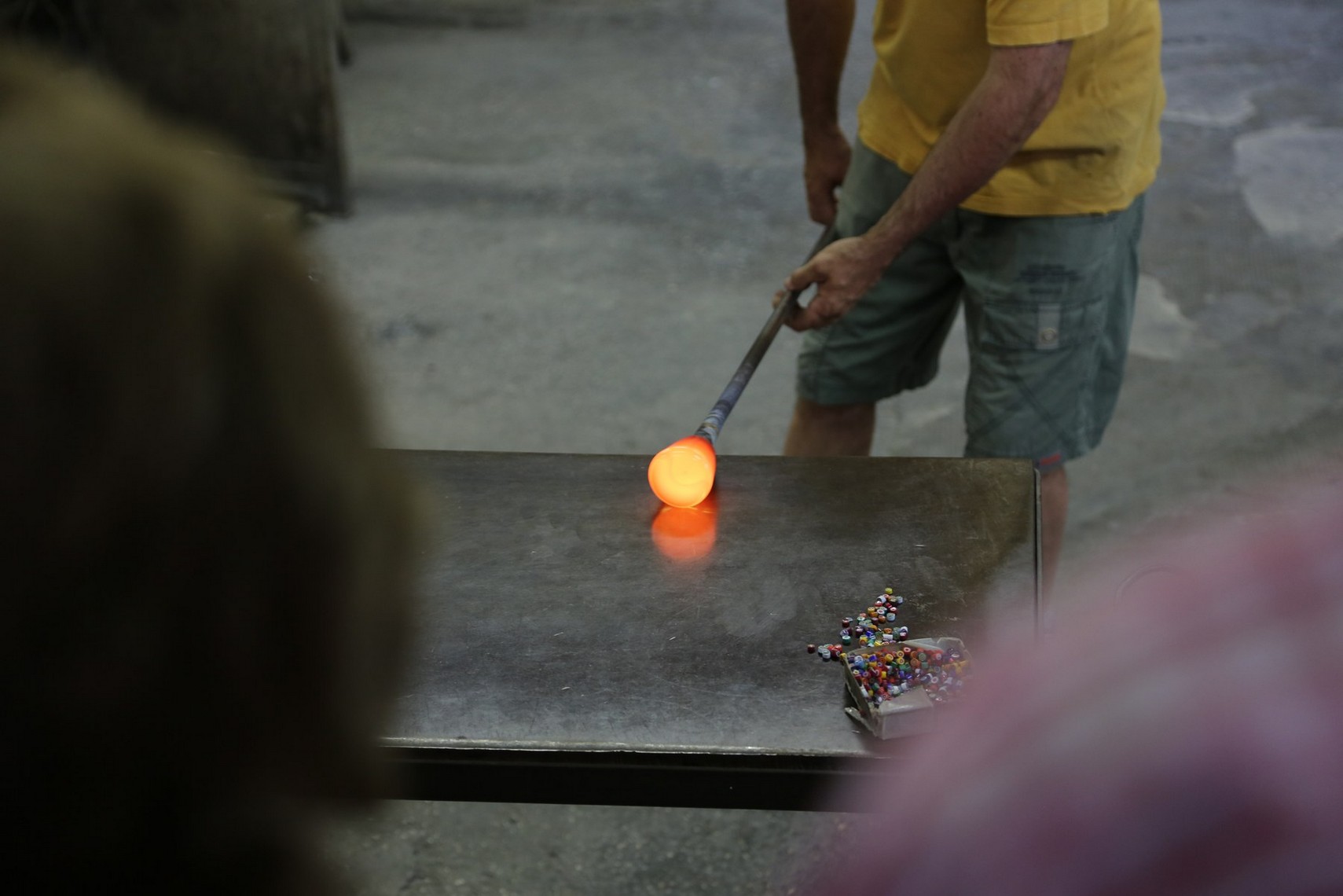
4. Two roads: it's the production model, not just geography
For anyone developing a Contract project, the distinction is not only about geographic origin: it is above all about the production model. On one side, work oriented to the one-off piece and to the fullest expressive freedom; on the other, organizations able to govern volumes, tolerances, certifications and replacements over time. These are prevailing vocations, not rigid categories: an island furnace can sign large serial installations, and a mainland workshop can make a one-off piece. But in most projects the choice is played out exactly there, on the production model.
There is also a legal fact worth knowing before writing a specification. The collective trademark «Vetro Artistico® Murano», established by the Veneto Region with Regional Law 70 of 1994, is reserved for pieces made in the island's furnaces and may be used only by authorized licensee companies. Production carried out on the mainland cannot use this mark: it may describe techniques, skills and productive tradition, provided the communication does not lead anyone to believe the piece was made in Murano or holds the related trademark. For an Interior Designer the consequence is concrete: «Murano» in a specification carries a precise legal meaning, and should be used only for pieces made on the island.
5. Thesis 1 — The one-off piece, for the one-off villa
Island artisanal glass is, by prevailing vocation, the territory of the one-off piece. It is born of an unrepeatable gesture and lives on what makes it so: a bubble, a thickness, a color that will not return identical. It is the natural choice when the project is a single one — a villa, a suite, an author's element — and non-repeatability is not a problem but exactly the value being bought. Here variation is not governed: it is celebrated. The specification, in this case, protects authenticity above all — where the piece is made, who made it, the island's mark — rather than uniformity.
6. Thesis 2 — Organized craft, for luxury multifamily
The organized craft of the mainland has a different vocation, for a different market. It is the handwork of glass brought inside an organization able to produce and certify volumes: the same techniques rooted in the Murano tradition, but with processes that hold dozens or hundreds of pieces together. The result is glass that stays unique piece by piece — because it is hand-blown — and at the same time consistent across the whole project. It is often the right road for luxury multifamily, where every apartment must have the same Venetian glass without the differences reading as defects.
This is where our method becomes decisive, and it is work we do together with the Interior Designer, not a lecture. We approve a master sample — the reference piece; we set a tolerance range on dimension, color, bubbles and thickness; we write the criterion by which a piece is accepted or rejected, and who signs off. For more complex commissions the master sample is paired with lot traceability, an agreed quantity of spares, stock and packaging and — for lighting elements — the technical and photometric parameters, such as color temperature and luminous rendering, to be maintained over time. That is how «unique» and «repeatable» stop being a contradiction.
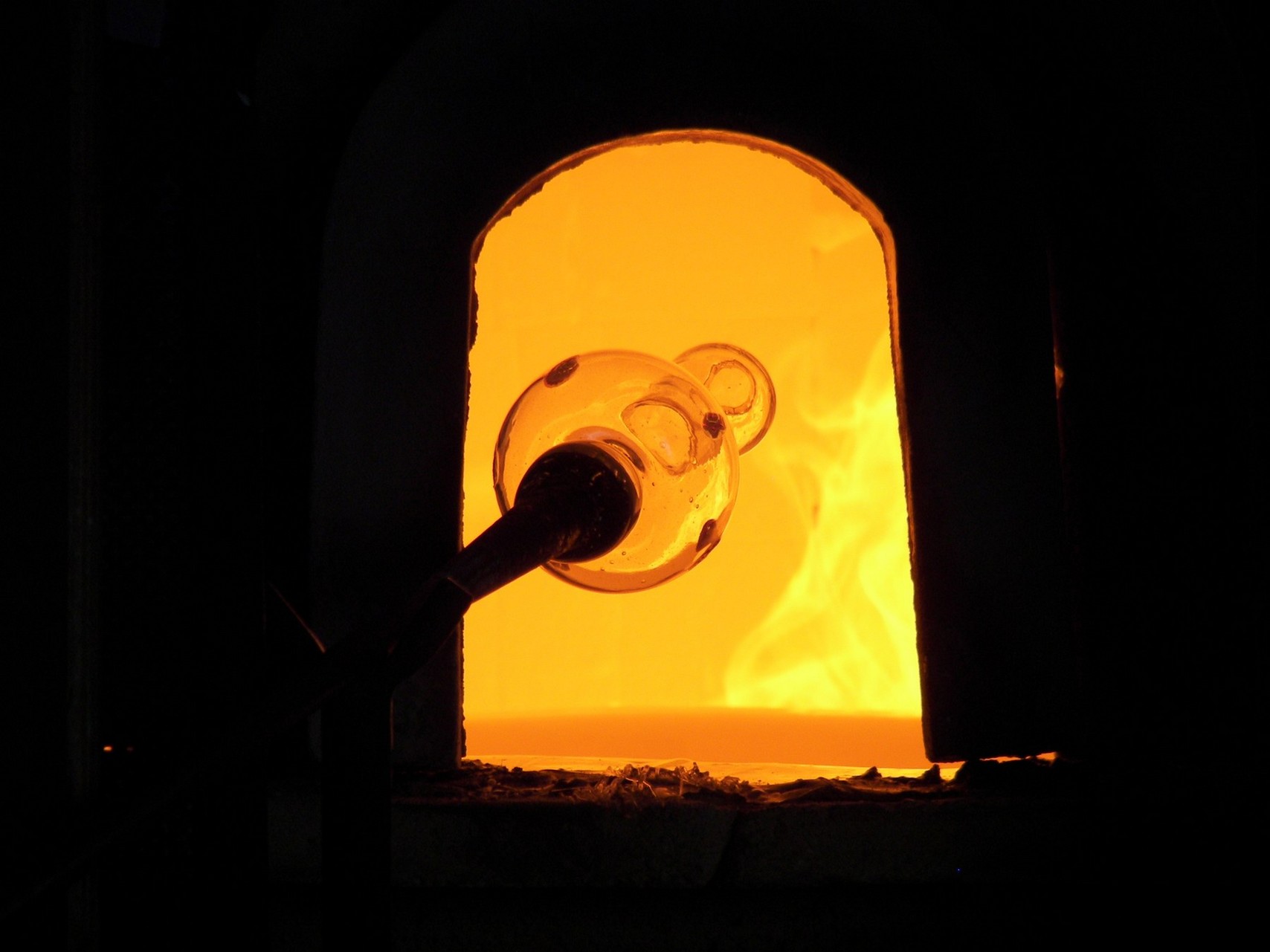
For a villa, Murano glass is a one-off piece to be celebrated. For a luxury building, it is the same hand made repeatable — and written into the spec.
For the next project
If your next project includes Italian art glass — mirrors, walls, light — the first question is not the price of the piece, but which production model the project needs: the one-off piece for a unique space, or structured artisanal production for an entire building. The second comes right after: where the glass is made — and therefore what name you can write in the specification — and with what tolerance, what spares and what parameters it will be produced, accepted and maintained over time.
Get New Insights via Email.
One article per month. No drip sequences. Unsubscribe in one click.